
Vision
To develop a globally connected, Africa-based research platform generating rigorous and locally relevant science across molecular biosciences, food systems and population health.
TOMBio, Translational One Health and Molecular Biosciences, is an emerging multidisciplinary research initiative being developed in Kenya to investigate the interconnected biological, microbial, nutritional, environmental and community determinants of health.
Research is organised around three connected themes: non-communicable diseases and metabolic health; food systems, microbiomes and health; and community health and primary healthcare systems. These are linked by a cross-cutting foundation in molecular and translational biosciences.
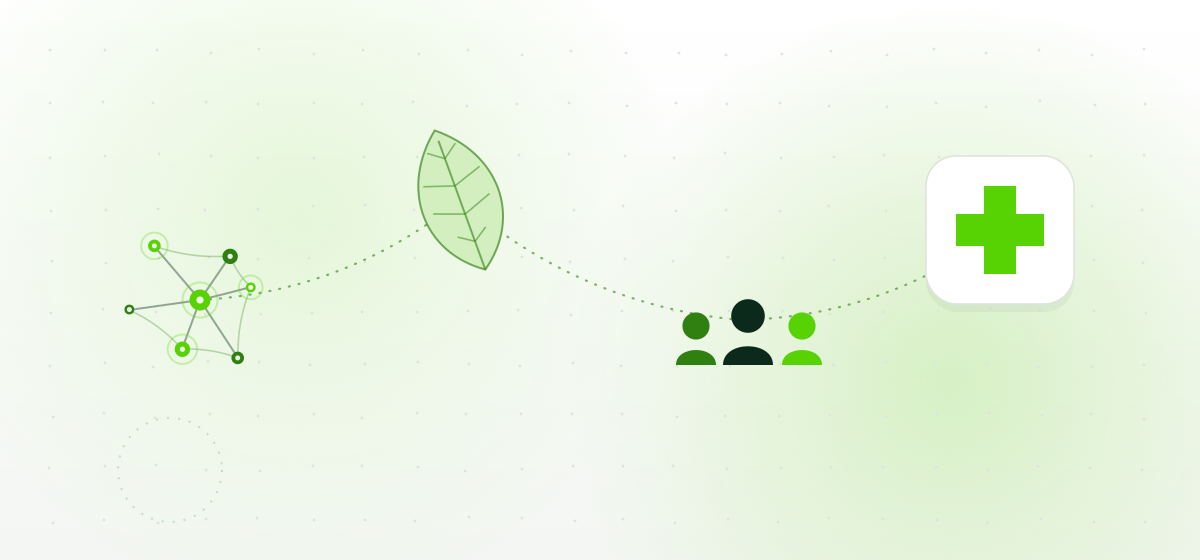
Diet, metabolism, microorganisms, food environments, immunity, community conditions and healthcare systems interact across multiple levels. A finding at one level rarely explains an outcome at another. Understanding why metabolic disease is rising in a given population, or why a locally fermented food behaves the way it does, or why a screening programme reaches some households and not others, usually requires evidence drawn from several levels at once.
TOMBio was conceived around the need to investigate these relationships across disciplinary boundaries while maintaining scientific depth within individual research questions.
Not every TOMBio project is expected to span every level of investigation. Instead, TOMBio provides an interdisciplinary environment in which complementary approaches can be connected when the scientific question requires them.
What TOMBio is working towards, and how it intends to get there.
To develop a globally connected, Africa-based research platform generating rigorous and locally relevant science across molecular biosciences, food systems and population health.
To investigate the interconnected biological, microbial, nutritional and health-system determinants of health, while strengthening research capacity, postgraduate training, collaborative science and research leadership in Africa.
TOMBio develops integrated research questions that connect laboratory and molecular science with food-system, population and community realities. Research can therefore move across levels of investigation, from biological mechanisms and microbial processes through to individual health outcomes, community interventions and health-system implementation.
The direction of travel is not fixed. A question can begin in a community and move into the laboratory, or begin at the bench and move into a health system. What matters is that the levels remain connected.
Methods are selected to answer the research question, not the other way round.
Interdisciplinary framing, disciplinary rigour inside each component.
Locally available infrastructure combined with specialised national and international platforms.
Evidence developed with its route to intervention, service delivery or policy in mind.
African communities and environments contain valuable food practices, biological resources and locally developed knowledge systems that offer opportunities for both fundamental discovery and applied innovation. Indigenous foods, locally adapted crops, fermentation systems and preservation practices emerge within specific ecological, cultural and socioeconomic settings, and they carry scientific information about those settings.
TOMBio combines place-based knowledge with contemporary molecular, microbial, nutritional and population-health approaches to develop research that is scientifically rigorous, locally grounded and internationally relevant.

TOMBio is being developed as an independent scientific identity capable of operating within the structures and strategic priorities of a host academic or research institution.
Depending on institutional arrangements and future growth, TOMBio may function as a research group, programme or collaborative research initiative while maintaining its core scientific identity and research direction.
Its activities are intended to complement existing institutional research programmes through multidisciplinary research, postgraduate training, externally funded projects, and national and international collaboration.
Two strands that run through everything TOMBio does.
TOMBio strengthens research capacity through postgraduate supervision, early-career researcher mentorship, collaborative training, scientific writing, grant development and participation in multidisciplinary research.
Students and early-career researchers are integrated into broader research projects and into national and international collaborations, rather than undertaking isolated academic exercises.
View OpportunitiesComplex research questions require complementary expertise. TOMBio develops collaborations across disciplines and institutions, connecting molecular biosciences, microbial ecology, food systems, population health and health-systems research.
Collaboration is structured around genuine scientific partnership: joint study design, shared grant development, co-supervision, shared data interpretation and shared research outputs.
Collaborate with TOMBioExplore how TOMBio's three research themes are structured, and the cross-cutting scientific platform that links them.